Wages of Sin Gave Me a Midlife Crisis
One hundred bounties, fifty planets, ten hunters, a courtroom procedure, and a carceral moon.
I’ve never liked the “200 npcs, 55 burgers, 55 fries” approach to selling books. At its best, those numbers are a reductive marketing stunt. At its worst, it promotes naked gluttony as an unexamined ideal. Whatever problems the Mothership ecosystem has, it’s surely not a dearth of quality short-form adventures. Moreover, “Bounty Hunters” as campaign premise invites your players to imagine themselves as the most overdone of all player archetypes - the hardened badass - in a system tailor made to deny that fantasy.
Turns out Tuesday Knight Games buried the lede.
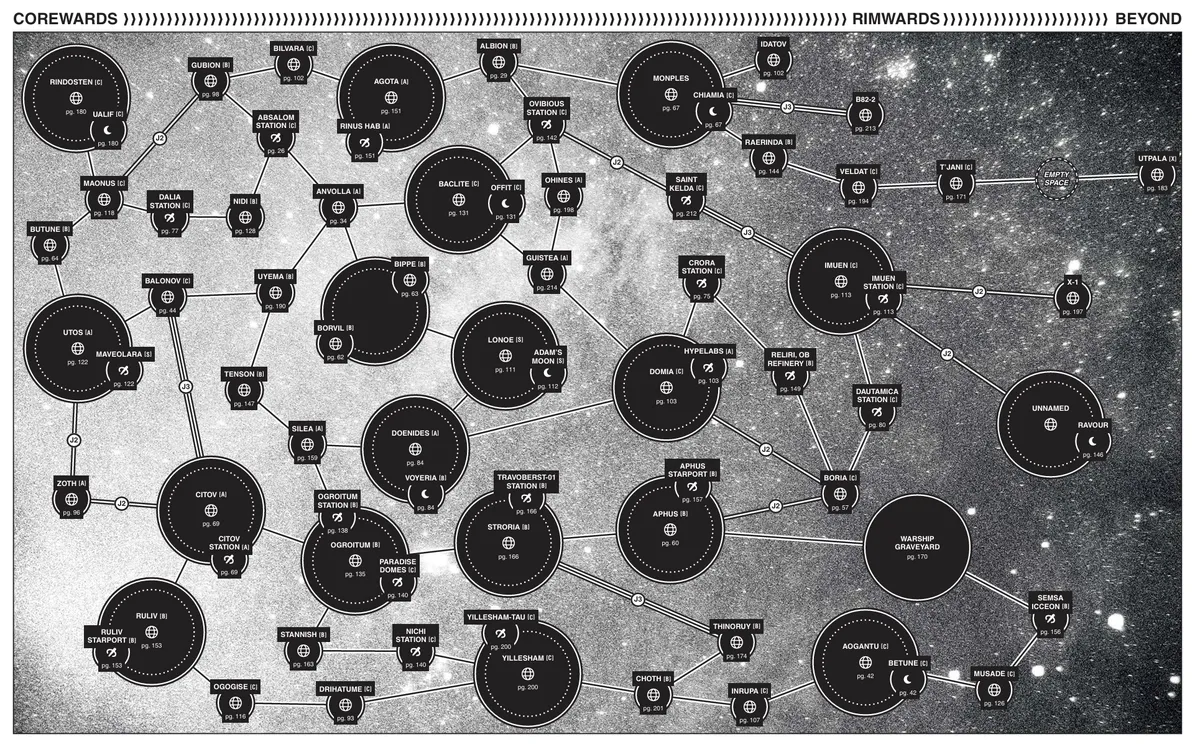
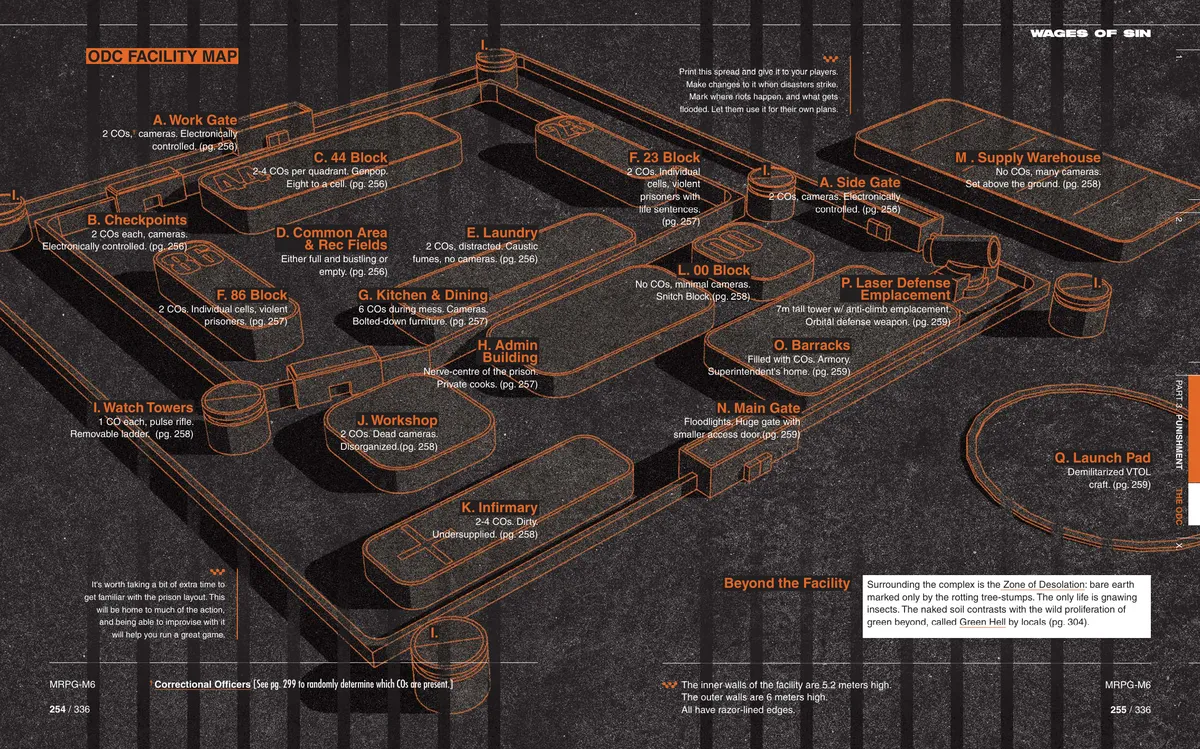
Good lord, look at this map.
Notice those page numbers? Those port class letters in brackets?
Wages of Sin is a compilation and a toolkit, yes, but it is foremost a galactic setting and therein lies its true value. This is Mothership’s riff on Dolmenwood. It is the cassette futurist connective tissue waiting to act as the backbone to your campaign.
Gearing’s poetic brevity and Crader’s vicious editing reduce what in other books would be full page spreads of dry demographic details into single evocative paragraphs. That saved space is then spent on the machinations of the broken humans living therein. Wages as a setting is chiefly portrayed through the problems of its residents, and thereby never drifts its focus from at-the-table utility.
What makes this book remarkable is not the number of planets, bounties, maps, and NPCs. It is, as is so often the case with TKG’s work, the density of that information. The jump to hardback has for the first time brought room for McCoy and McIver’s1 layout to breathe. This three-hundred page hardcover delivers what other books struggle to match in a thousand.
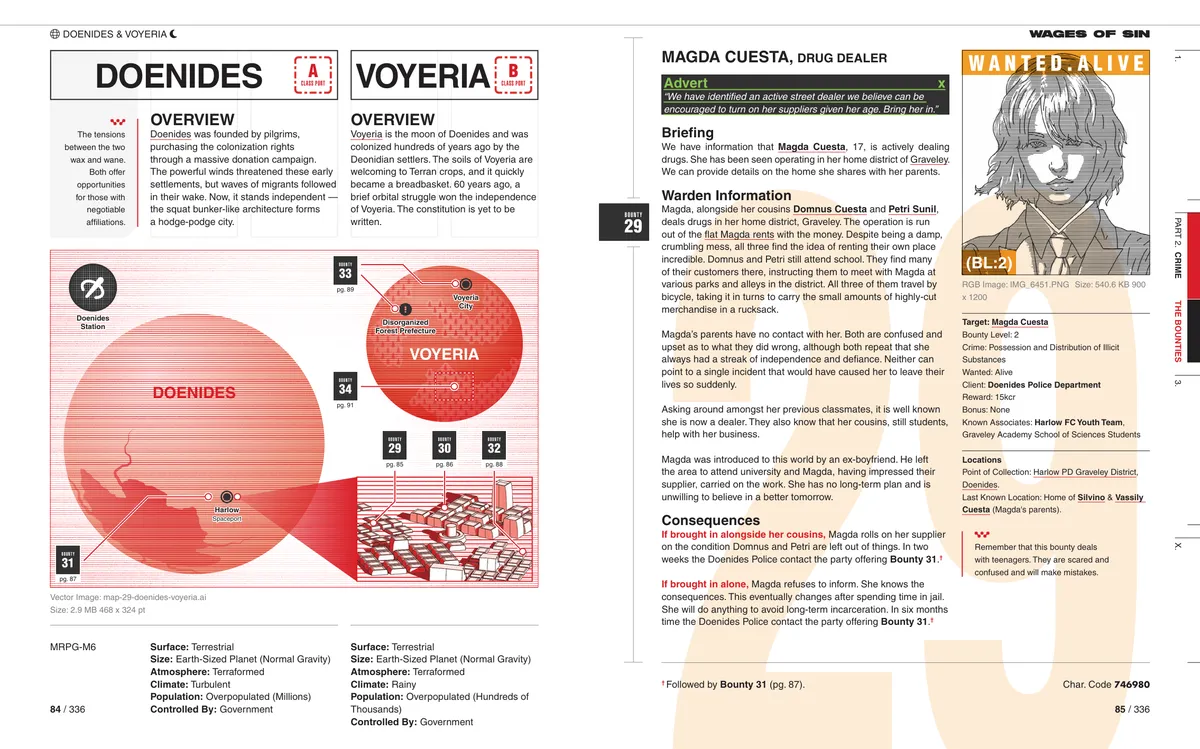
An example bounty: Arrest this 17-year-old drug dealer
Last known location: her parents' house.
This alone should raise red flags to any player paying attention. Let’s assume they take the bait anyway. Just imagine how that conversation’s going to go at the table.
Knock knock
“Hello Mr. and Mrs. Cuesta, there’s a bounty out for your child. Don’t worry, we intend to take her alive. Could you show us to her room please?”
Thankfully the parents are disconnected enough from that poor girl’s life to have no idea where she is or why she would leave.2 After all, wasn’t her life wonderful? A nuclear family footing the bill for prep school on an A-class port is more than most Mothership NPCs get. She was even on the soccer team.
Pay no mind to the square mile of wind-blasted bunkers that comprise her entire world. That every meal she’s ever eaten was delivered in freeze-dried palettes from a verdant moon she sees, daily, lit up like a Christmas tree in the night sky. Her reaction to those circumstances may have been shortsighted and immature, but nobody chooses to abandon hope. Thank god your players have the perfect tool to set this girl on the right path - six months of prison labor.

Of the 100 bounties in the book, about 80 are like this - nightmarishly relatable ripped-from-the-headlines depictions of societal failures big and small. There are missions about pandemic containment, pacifying a violent anti-immigrant mob, and capturing a runaway spouse. Wages doesn’t force your crew to think about the broader context of what they’re doing - it’s too classy for that. The horror of your complicity in the prison-industrial complex just sits there, waiting for everyone to acknowledge it.
The genius of this setup is that it establishes an oppressive capitalist baseline against which the more outlandish bounties - and the more lurid Mothership modules you already own - can contrast. By building a world instead of a narrative3, Wages doesn’t fight for focus with the modules you plug into it. Interconnections between bounties are present, but light. This book heavily relies on the consequences of past bounties ricocheting out of control to build tension over a campaign - and trust me, the fallout of these jobs is up to the task. Recurring villains, political revolution, and economic collapse are all on the table.
Okay, but are the missions, like, fun?
A fair question. You can’t build an engaging campaign out of kidnapping helpless teenagers forever.
This is arguably the hardest hurdle for the book to clear, since most people playing MoSh are already gorging themselves on the best one shot adventures money can buy. How much better can a collection of one shots possibly be compared to the best third-party publishing community in RPG history? Thankfully, I went through a manic episode two years ago and read a hundred Mothership modules in a month. I went back into my HDD, pulled out all 53 one-page and trifold adventures, and graded all of them on a petty, reductive tier list. The scale is as follows:4
S - Year of the Rat
A - The Haunting of Ypsilon 14
B - Radio Free Hecate
C - Moonbase Blues
D - Chunky Cheese’s Eateria
F - ALCOR Station Fuel & Services5
Then, I graded every bounty in Wages of Sin on the same scale.
Here’s the result.
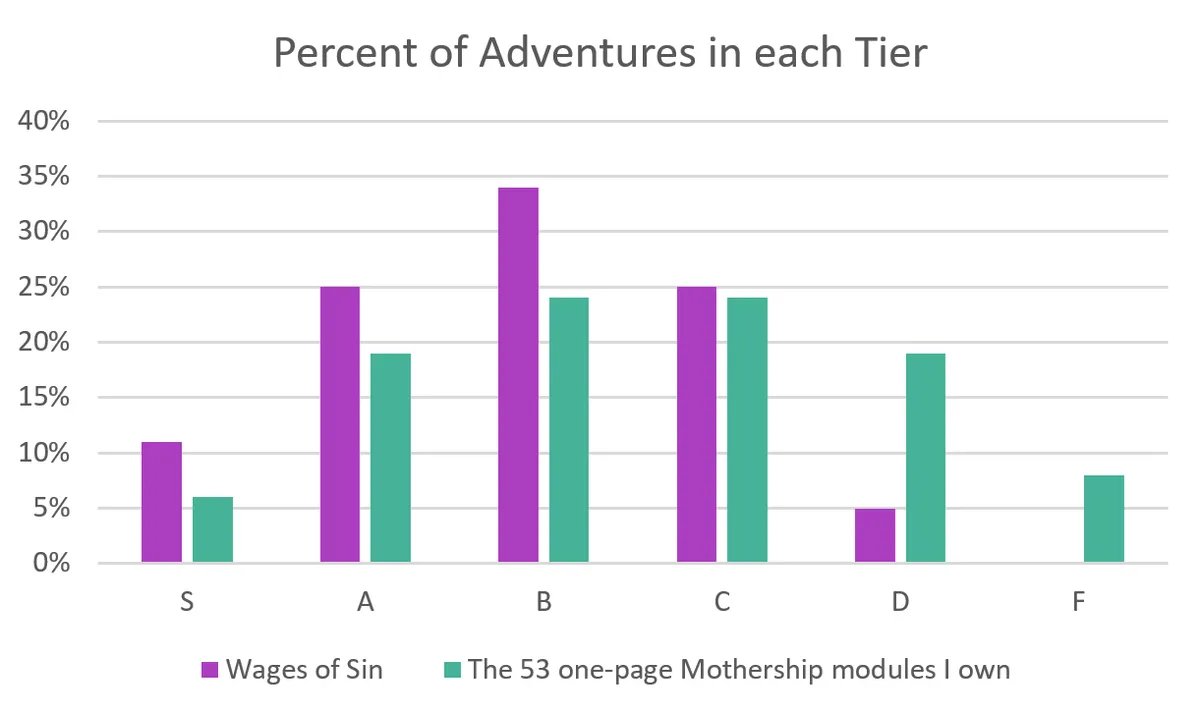
Lord forgive me for this belittling reduction, but I only have so much writing time. If Sean McCoy wants me to write hundreds of reviews he can pay me.
The upshot here is, yes, I think the average Wages adventure is meaningfully better than the average MoSh adventure. That’s a remarkable accomplishment for one writer, and makes me feel more than a little silly for spending a month interweaving modules into my own sandbox sector map.
A lot of these grades could have been higher, but were dragged down by light map support. All but two bounties in the book have some sort of map, but the accompanying map varies between:
- Room scale (a conventional dungeon crawl)6
- City scale (3D buildings marked “the diner”, “mara’s house”)
- Planet scale (A continent with “the capitol”, “the union base”)
I anticipate discourse about this, even though TKG does their best to lessen the sting of this compromise. There’s a half page of “improvising details” advice, one of the WES footers includes a genius room layout oracle7, and the familiar modern environments make improv comparatively easy.8 But I doubt even all of these tools in tandem would make a new warden feel comfortable running Wages. This is an “experienced wardens only” product in my mind.
Wages has more than bounties to offer
Let’s talk about that prison colony.
The back third of this book contains procedures for:
- Quickly adjudicating evidence left by player crimes, and whether a bounty gets placed on their heads.
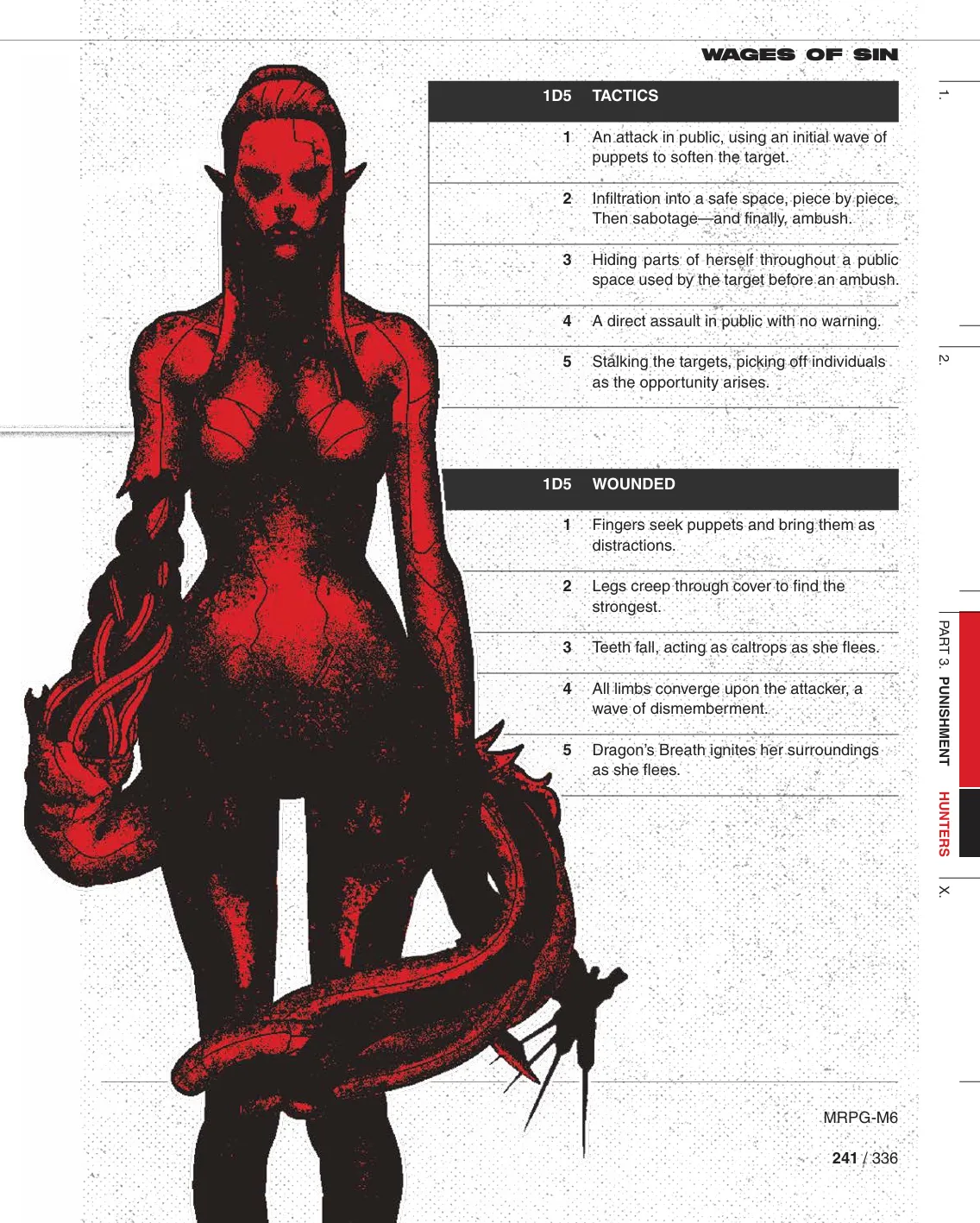
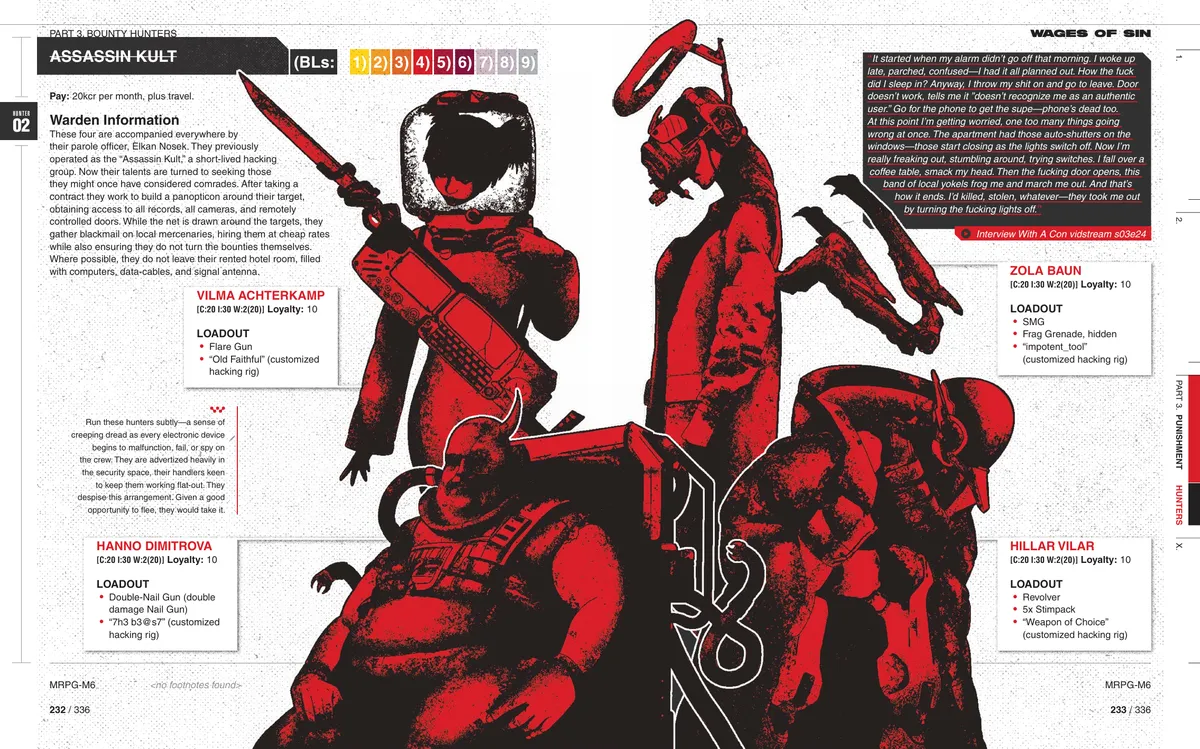
- Ten bounty hunters so outrageously interesting that I’ll only spoil my favorite - an eye patch sporting, bubble gum blowing, trench-coat wearing woman who uses Fiverr to pay all of society to ignore and/or gangstalk you.
- A full criminal trial, including hiring a lawyer, plea deals, discovery, the trial itself, and sentencing.
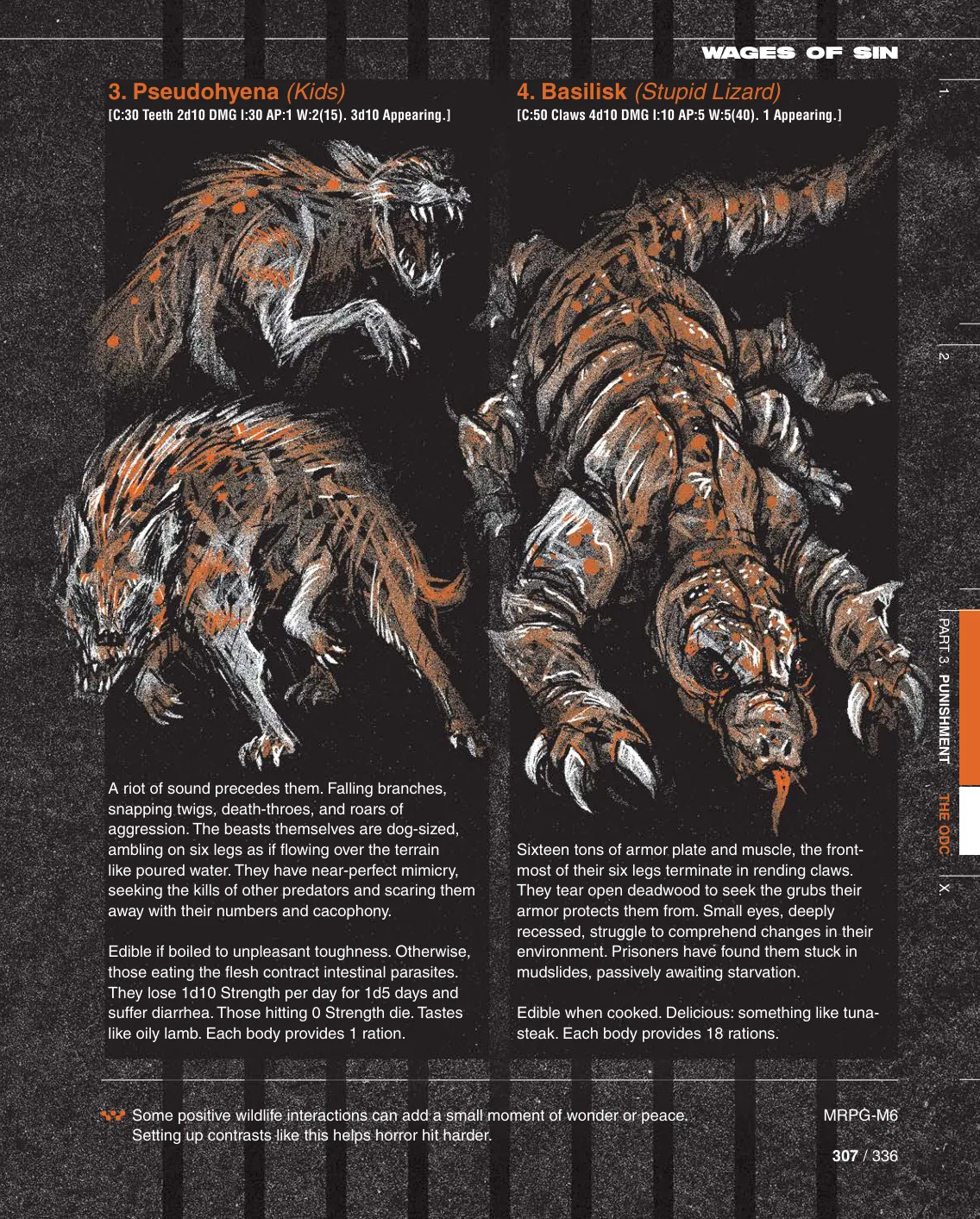
And that’s just the appetizer, baby. Play transitions to a week-by-week distant resolution procedure in which crews pursue goals while surviving three dozen random prison events and the omnipresent risk of gruesome on-the-job injury - both from the backbreaking logging work which funds the prison, and the bloodthirsty monsters infesting the woods.
Oh, and look over there, holding that chainsaw - it’s everyone the players have ever arrested! They look so happy to see you! Perhaps the guard will do his job if you roll under his bribe stat. How’s that escape plan coming?
There’s enough here to run a campaign for ten years
And that’s before I inevitably add Karth, Mani, Warped, Yonkers, and every other first-party MoSh zine into the stew.9 The Mothership Deluxe box has already been my go to recommendation to indie TTRPG first timers since its release. Now that Wages exists to support that preexisting content, I genuinely think these are the only two products a sci-fi roleplayer needs to run excellent games for the rest of their life.
Which raises the question: at this point, why do I even run games that aren’t Mothership?
It’s not perfectly to my aesthetic taste (there aren’t enough women with swords), but if I just stopped here and allowed myself to be satisfied with the A-tier game Tuesday Knight Games is offering, I would save hundreds of hours in prep and hundreds of dollars in book purchases every year. Of all the campaigns I’ve ever GM’d for this blog, I was happiest running Mothership, precisely because of the support its modules gave me.10
Wages of Sin makes me feel foolish for GMing games that aren’t Mothership. If blorby simulationist thinking adventures are your jam, Tuesday Knight Games is running laps around the competition. This book is a maestro singing in concert with its community.
$50 hardcover, $80 for the sexy cloth and foil Deluxe cover.
————————————————————————
The Baseline Boys? The Tuesday McKnights? I’ll think of something eventually.↩
How achingly familiar.↩
NSR modules like to talk a big game RE: “there is nothing that is supposed to happen”, yet consistently choose to provide GMs with each of the component parts of a dramatic three-act structure. The Caliban plot line of a Pound of Flesh, for example, certainly has a preference about the rough order in which players encounter its component parts, even if it’s (rightfully) philosophically unwilling to force a specific outcome.↩
I will not be justifying this rubric. I will especially not be justifying my claim that Moonbase Blues is mid.↩
Arguably more of a D than a true F, but I wanted to link a module that was worth attention instead of punching down on a first timer. The art is great, the premise is unique, but the scenario's writing and follow through is bad.↩
A little less than half of these “dungeon maps” are ship layouts. Some are standard ship layouts from the Shipbreaker’s toolkit, others are brand new ships included in the book’s appendix.↩
Drop a fistful of dice. Every 6+ is cover, every 0-2 is a feature unique to that room.↩
I have no idea what the inside of a feudal granary looks like. I know a great deal about the interior of brutalist low income apartment complexes. My life is far closer to that of a Mothership character than Gandalf.↩
The only campaign frames left I lack a polished procedure for are trucking & salvaging, and if all goes according to plan Sam’s got me covered.↩
I think, once Girl Frame is done I’ll hold myself to “Mothership + a fantasy game” forever. If you notice fewer system reviews and more coverage of obscure trifolds by this time next year, you know why.↩