My Dad’s First RPG was Roach Motel

He’s a Sixty-nine Year Old Blue Dog Democrat.
Lived his whole life in West Virginia. Hates Trump, loves cigars, wants to leave the queers alone. Every bellowed declaration a dare to the world around him - the “fake it till you make it” kind of bravery.
Unsurprisingly, he doesn’t “get” my hobbies. Once bought me an oversized airbrushed grim reaper t-shirt because that’s the closest thing to Tetsuya Nomura in the mind of a middle aged basketball referee. But I know my proclivities came from somewhere, and I’ve seen the way he sat enthralled as my teenaged self fought Shinra grunts in Dirge of Cerberus. Despite his masculine protests I knew he could be corrupted.


Roach Motel is my Favorite Megadungeon
Thirty-four pages, 135 rooms. As in Dead Weight, there is no climactic villain. Evil has already won and absconded five years prior. The nightmares depicted are mostly the unintended consequences of a kindhearted office woman trying her best.
The facility traps you inside. Not in some crass, pedestrian way - there’s no falling boulders, locked doors, or collapsing tunnels. The trap takes its time. Most parties won’t cross the threshold for hours, and won’t realize they’re trapped for a long time after. It’s a trap that can’t be perceived.
The Twist
An unfathomably traumatized innocent1 named Jamie has lived five years off Subway and rats in the bowels of a mothballed R&D facility. For science bullshit reasons this man:
- is tethered in front of the facility’s only intended egress.
- asks for your weapons and food (you must obey).
- escorts you away from the entrance, to other random locations (you must obey).
- erases himself from your memory.
He was never taught how to speak and means you no harm. He just knows that the people who leave his home never come back. To an ignorant child, that is indistinguishable from death.
I’d like to bask in how insanely good of a premise this is. From the players’ perspective the memory-hole seems like a surreal teleport - here one second, somewhere else the next. It’s only when backtracking that players realize the sterile corporate hallways ‘don’t lead where you remember’. The module tempts players to assume they’re in The Backrooms, while in truth remaining grounded enough to reward experimentation. There’s a narrative arc built in, from helplessness to empowerment.
Norgad emphasizes at length that you should not “hint” at Jamie’s existence, flying in the face of ICI. Light tinnitus and a Sanity save are the only cues, at first. But Jamie does follow defined rules - rules that must be learned through careful exploration. The module reminded me of “Metroidbranias” like Tunic and Outer Wilds. The world never changes; you change to master the world.
My Dad beat Roach Motel in 3 Hours
His wife (another Gen X normie) and my sister (earned the Gold d20 in BG3) rounded out the crew. My Dad, playing a marine, immediately assumed the leadership role. From minute one he was clearing rooms, fictional AR-15 at the ready.2
When the vandalized top floor failed to offer the whereabouts of the missing person the party was tasked to rescue, he set up a perimeter and staked out the joint for twelve hours. When no one came or went (itself useful information) they descended twenty floors, cut the power lines to the magnetically locked doors, and unknowingly encountered Jamie for the first time.
Here’s a collection of my father’s speculations about “what was really going on”:
- "The hotel staff have degenerated into a murder cult. They are feeding us all to the rats."
- "This facility is run by feral children. They are watching us. Subtly tempting us down false paths to satisfy their malice and hate."
- "Everyone is dead, we’re going to be dead, this is all the fault of you stupid god damn women."3
He found the missing person, bested a pair of cyber assassins in a knife fight via a fortuitous crit, then explained how he could use a crowbar and a live high-voltage wire to knock out power to everything connected to the local circuit. (I understood none of the latter explanation, but he’s built a house from scratch and I haven’t so I let him roll for it.) With power temporarily disabled and Jamie disarmed, he casually put a bullet in the immobilized invalid’s skull while jogging out the exit.

Most “How to Teach TTRPGs” Advice is Misapplied
The traditional lines I've heard are
“Use movies they’re familiar with to explain the tone”
“Introduce the rules slowly in play.”
“Use pre-generated characters.”
“Run a quick, tight game with five or six action packed rooms.”4
But that isn’t advice for teaching TTRPGs, those are band-aids for D&D’s problems. Turns out, old normies love role playing games when they aren’t awkwardly glued to a tactical miniatures game. My elder newbies both expected two hours of miserable geekery - said as much to my face - but instead found themselves so enthralled that they didn’t realize three hours had passed.
Here’s some better advice.
- Don’t treat new players like children5.
- Play games that respect their time.
- Open with opportunities for meaningful choice. “You’re in a deserted alley. There’s a capsule hotel to your left and an abandoned bar to your right. What do you do?”
- Give characters mundane names. I renamed the missing person at the center of the module from “Tama MacKenzie” to “Ted”.6
- Keep the distinction between player and character ambiguous. Don’t ask them to name their characters - get them into pawn stance as soon as possible. You want to minimize the distance between your new players and the imagined space.
Did I mention that the zine is good?
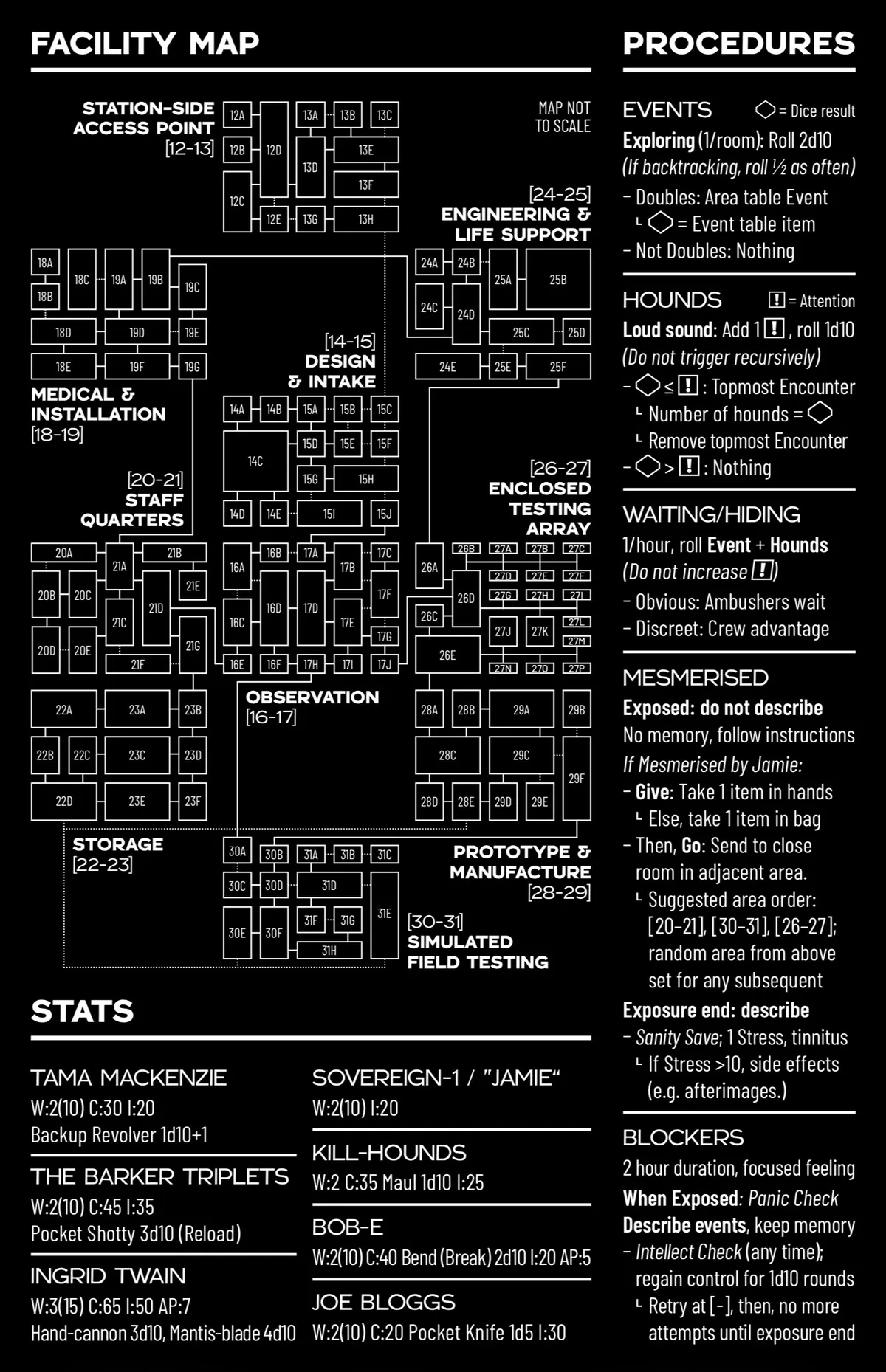
Norgad remains on the bleeding edge of Mothership’s layout trends. His trademark brevity plays perfectly with the density of Owe my Soul to the Company Store and Ypsilon-14's room-key-as-pointcrawl layout. In five years' time I expect the MoSh-heads will be running games off beveled runic script; each glide of their fingertips sightlessly absorbing information like a living barcode scanner.
I was skeptical of some of these procedures at first, in particular the low odds of random encounters and the choice to separate those random encounter checks from the escalating danger of “wandering Hound checks”. However, I warmed up to both in play.
The Hound check procedure is complicated by MoSh standards, but determines the presence of an encounter, type of encounter, and the number of hounds encountered with a single roll. It only triggers when players are carelessly loud (six times total in my case), which makes it feel more exciting than burdensome. Those ruthlessly intelligent feral dogs are what sold me on the module in the first place.7
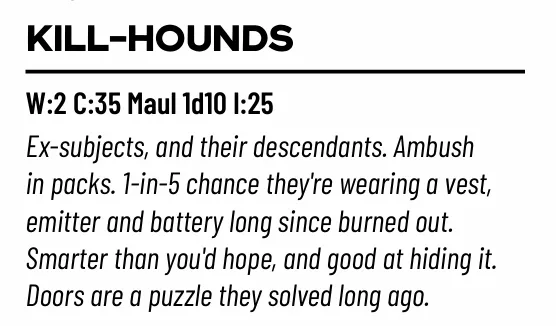
Random encounters are instead checked per room, and only trigger on doubles on 2d10 (the matched digit determines which encounter is triggered - clever). But unlike the Hounds, these encounters are not an attrition mechanism. They’re the primary way you encounter other trapped people, including the man you’re here to rescue. These strangers are desperate, but they’re also all rational - they can be talked into becoming allies. If anything, these encounters are beneficial on average.
But, crucially, your players do not know that. All they know is that when they asked to backtrack to another distant corner of the facility, you hunched over like a little goblin, rolled the same d100 seven times in a row, then said "you hear running footsteps in the dark." As a player, just hearing the fall of unexplained dice is scary on its own! The checks themselves are performative, and the tense silence that follows 90% of the time is its own reward.
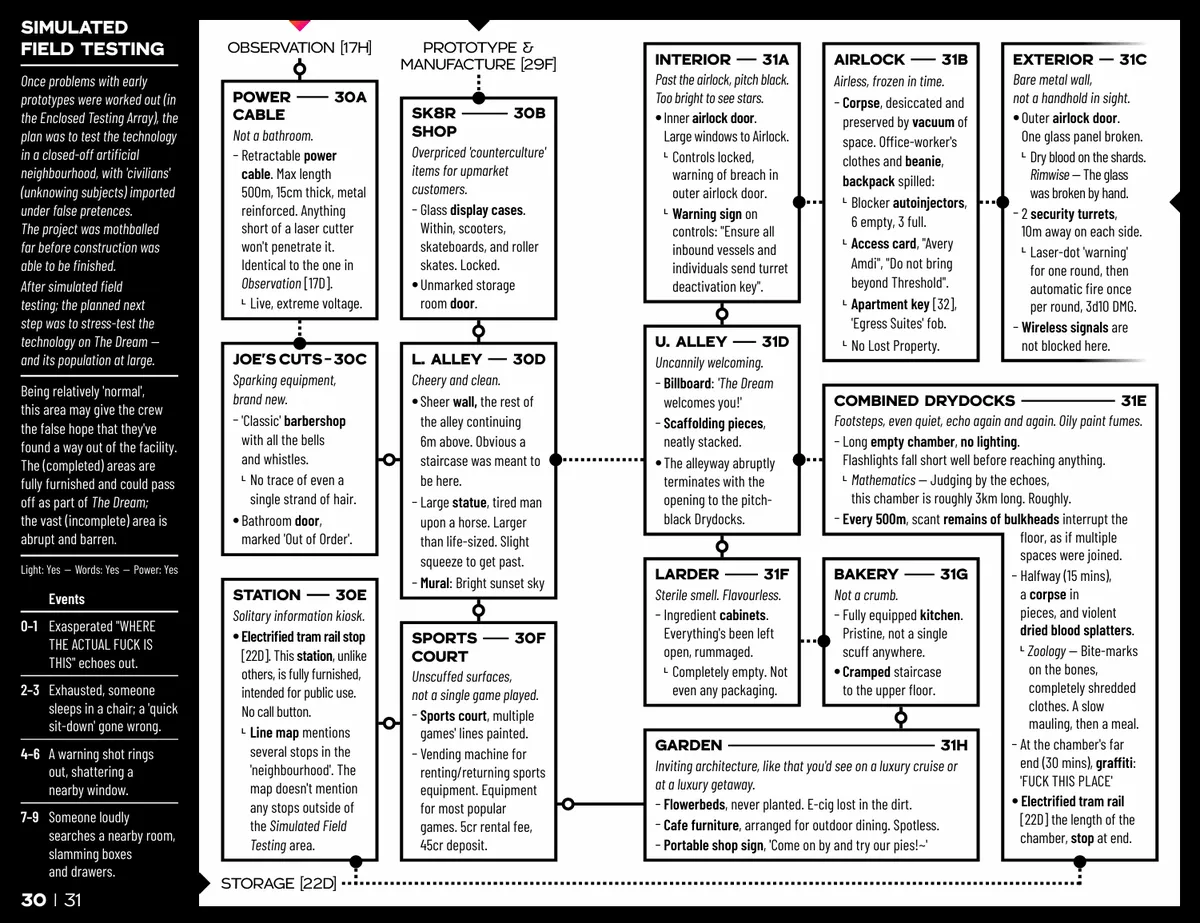
Roach Motel is just so overwhelmingly professional. The colors are restricted to a practical-yet-evocative palette of black, white, grey, and the uncanny pink-orange gradient of Jamie’s mesmerizing light. Each color has its own consistent meaning in the book’s sleek utilitarian visual language.
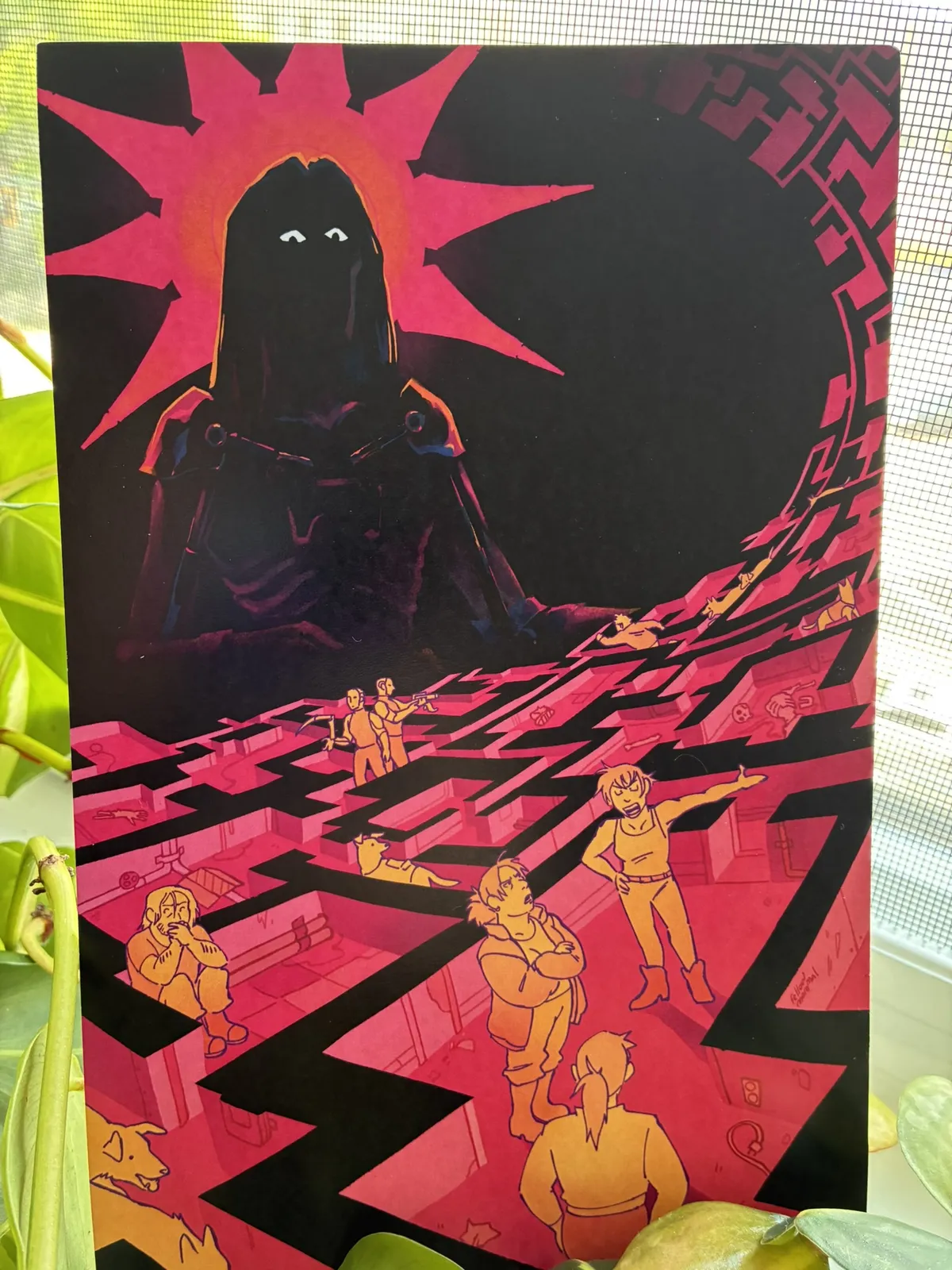
The creeping corporate claustrophobia of a hyper-dense layout remains one of my favorite conventions in MoSh’s third party ecosystem.8 Even the half-letter form factor of the zine itself plays into the dread. The booklet is oh-so-slightly taller and thinner than the other A5 zines on your shelf, as if the module, like the figure on its cover, is trapped in a trash compactor.
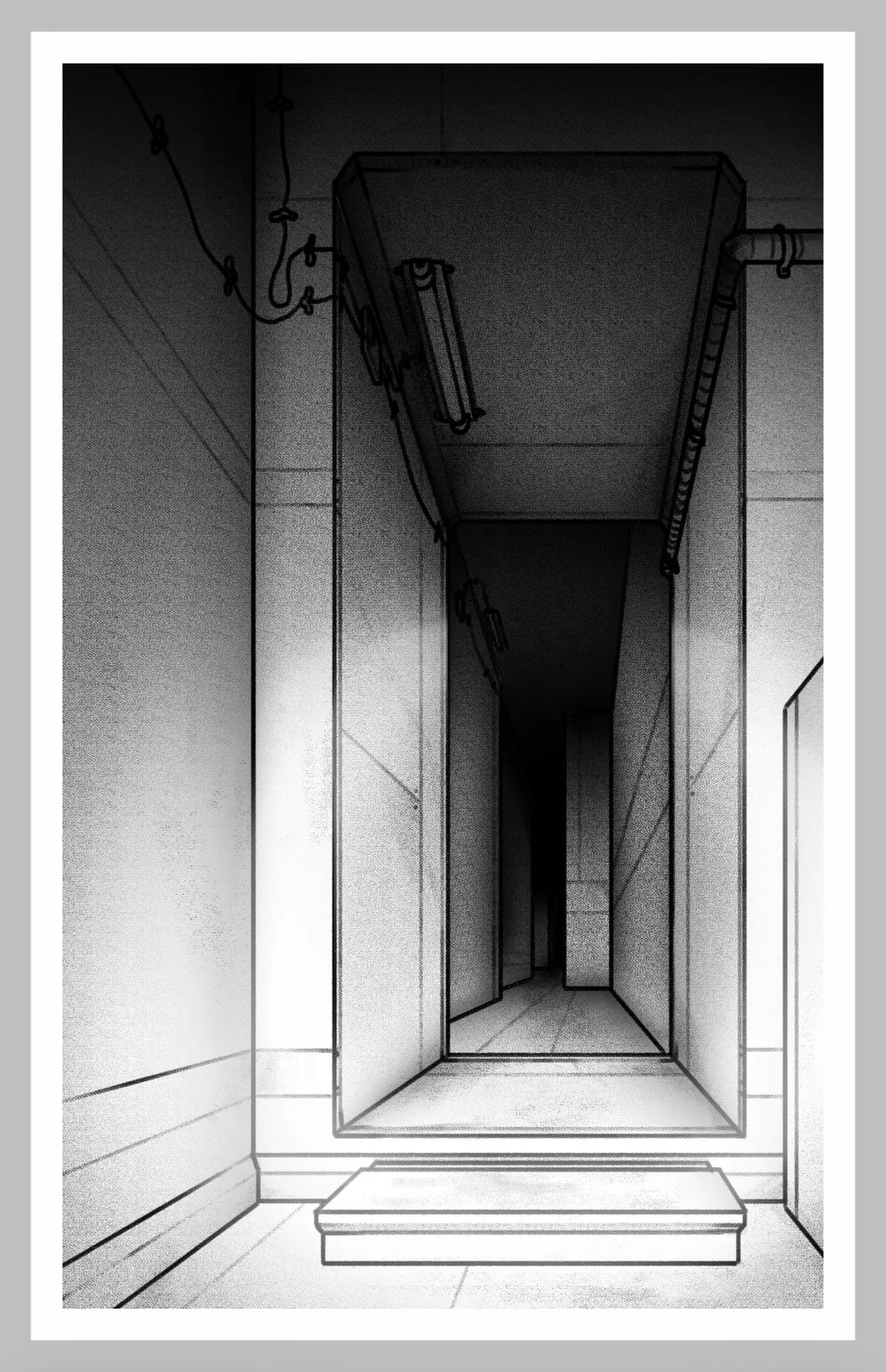
Most people’s mental model of a space station is anchored in the soft sci-fi of Mass Effect and Deep Space Nine - full of creature comforts and airy promenades. Despite its gargantuan size, Prospero’s Dream feels like a submarine; every inch of space compromised by the negligence and desperation of regular people struggling to survive in the cold hostility of space.9 The module dedicates an entire page (this module! which repeatedly squeezes ten rooms into that space!) to the art below. Roach Motel needs you to understand the grim encroaching silence of those inescapable hallways.
I don't think it's a coincidence that my father came away from Roach Motel finally understanding why I spend so much time reading these inscrutable booklets. If the joy of escaping alive wasn't enough, the shock on his face when I showed him the map of the facility - the sheer scale of what could have happened, the breadth of different stories their decisions could have told - gave him all the reason he needed to keep the dice set I let him borrow.
To make sure he owns a d20... just in case.
$10 Digital, physical copies at TKG and a designer’s commentary(!) coming soon. Buy it today and trap your parents inside.
———————————————
Ruthless enthusiastic practicality is apparently common in newbie Mothership boomers. God, what are the odds two bloggers would both rope their parents into Mothership just days apart?↩
My dad’s favorite joke is pretending to be a violent misogynist.↩
Have y’all figured out yet how much I dislike the phrase “action packed”?↩
Unless, of course, they’re literal children. Then… just try your best. Thank you for your service.↩
Couldn’t bear to rename Maureen Tui, though. I can’t wait to catch even more Over/Under references in the coming years.↩
So bummed that my family avoided them by sheer luck. (Six increasingly difficult checks, all passed - a 6% likely outcome.)↩
Sam, you can take these bullet points from my cold, dead hands. Wildly exaggerated visual hierarchy or death. I am not capable of ingesting 135 discrete rooms, and if that makes me a lazy reader then so be it.↩
These mismatched expectations of what Prospero’s Dream is were very visible during Over/Under. It was so interesting to see Luke Gearing himself play a character who’d never seen the sky - back literally bent by the grim realities of growing up in sci-fi Kowloon - when the majority of other players were imagining LCD skylines and indie bookstores.↩