Fomoria Inches Toward Trad
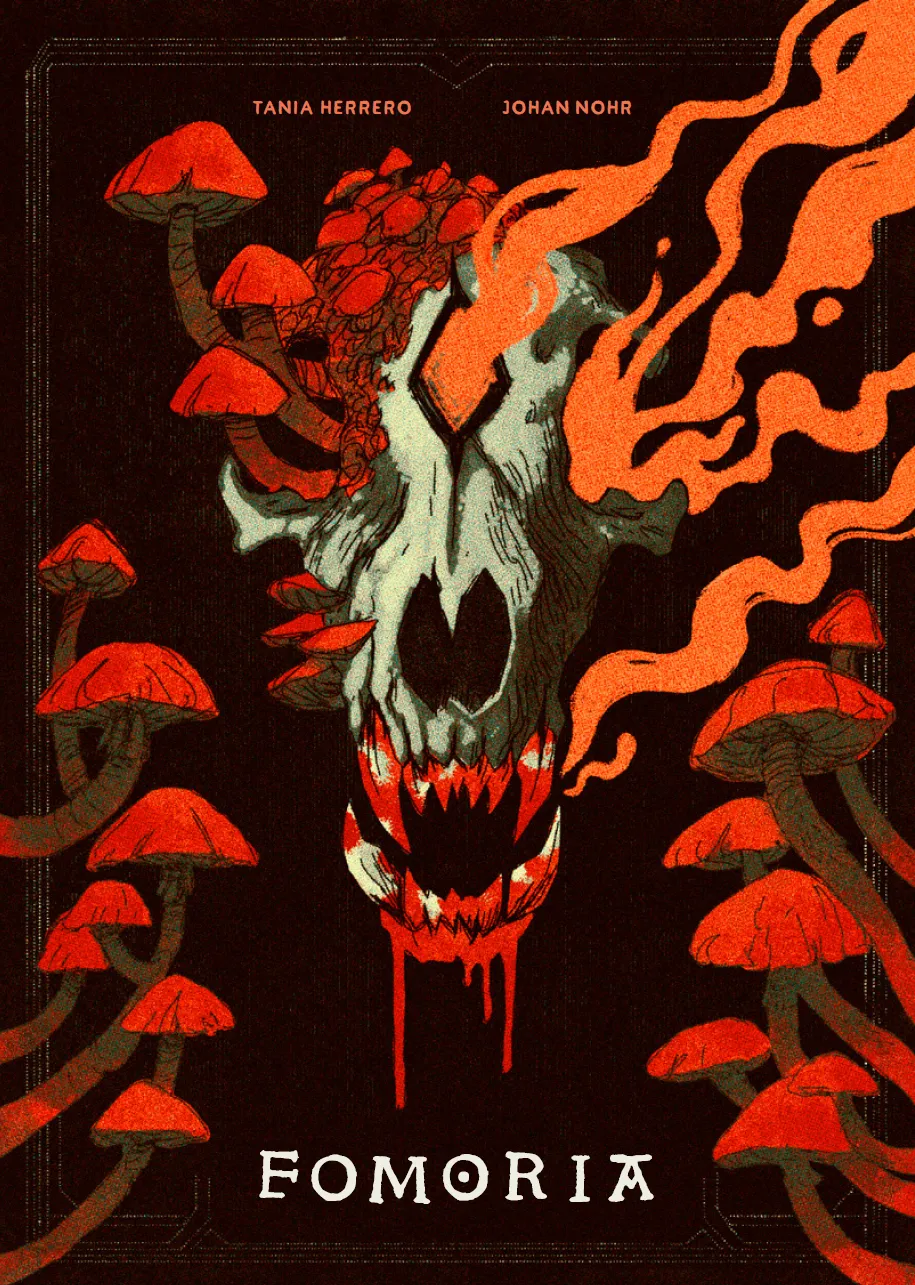
“Is it an art game?”
This was the first question my friend L. asked me after I finished running Spawn of the Hungering One, the intro adventure included with Fomoria’s free Quickstart rules.1 I wasn’t sure what she meant at first - every game is art, right? - but she was thankfully patient with me. Her real question was "is the game scaffolding for the art, or is the art a tool wielded in service to the game?"
In the moment, I gave no answer.
Since its announcement in April, Fomoria has been my most anticipated project in the scene. Everything Tania Herrero touches turns to gold. She’s three-for-three on Ennie nominations for her three prior hardcover projects, all created solo save for her occasional editor. A lot of that attention was baited by flexing her 2D animation training, yes, but her emotional sensitivity set the hook. Dread, failure, and betrayal made her beasts beautiful.2
So when I heard she was collaborating with Johan Nohr on a 300pg Mörk Borg conversion about anthropomorphic subterranean god murder? Gracious; say less. I was voracious enough to read the backer PDF cover-to-cover before physical fulfillment even began.
Fomoria started as Tania’s private worldbuilding project twelve years ago - the idle sketches she used to stay sane after a soulless nine-to-five, three years before DMing her first table in 2018. None of this began life as a consumer product. Rather, her prior commercial projects earned so much goodwill that two of the biggest names in the scene - Free League and Johan Nohr - agreed to format her daydreams for publication. Tania says this project is the hardest she’s ever worked in her life, and I believe her.
What’s in the book?
In order:
- 50pgs lore
- 20pgs core rules
- 70pgs character creation and advancement
- 10pg Encounter table and Miscast table
- 100pgs monsters
- 40pg one shot dungeon, plus pregens 3
Most of my opinions on the book can be inferred from the relation between these page counts.
The Setting
Dark Souls + Veins of the Earth + Secret of NIMH. Jacked eldritch Mausritter.
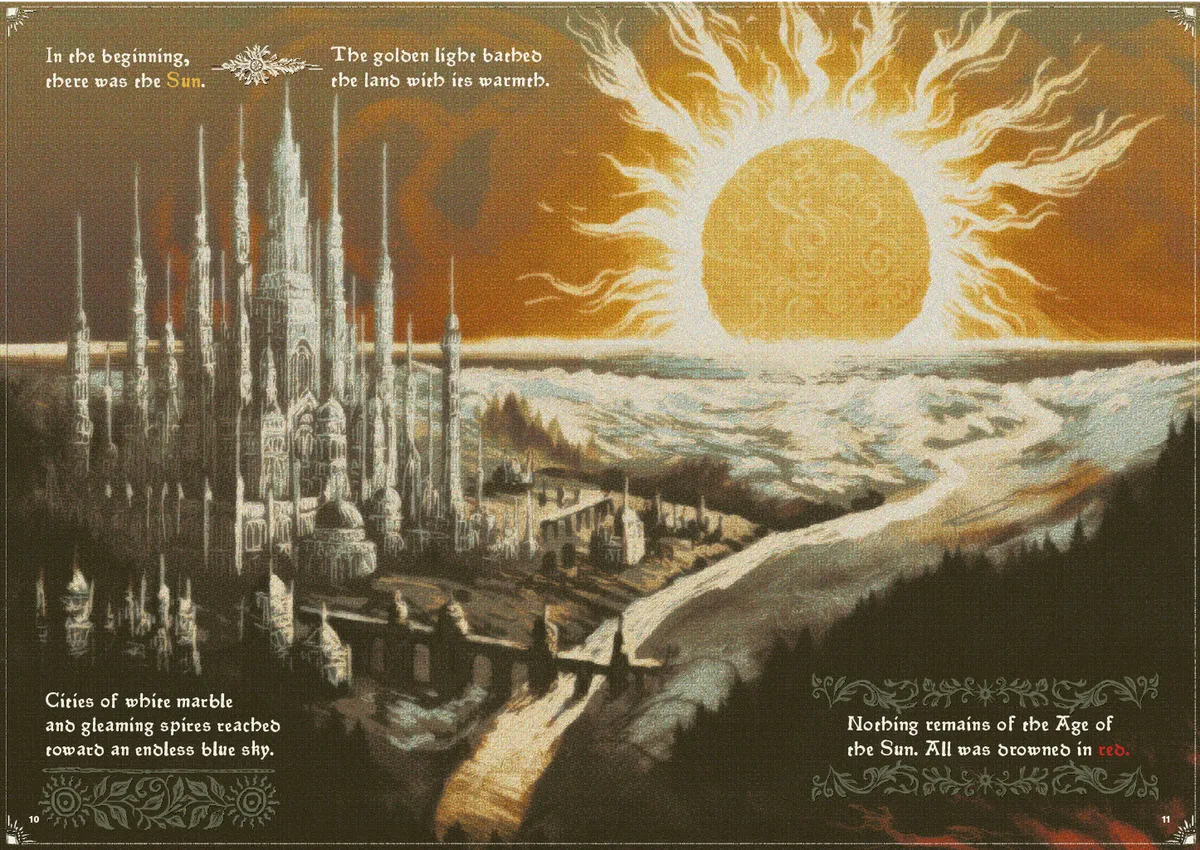
An immediate raving hit with my players. Tania’s artistry remains as captivating as ever.
The sun has drifted into distant legend after the surface world was claimed by a horrific, violent plague. Refugees fled in droves deep as caves could reach, and found a mythic underworld inhabited by deep gods indifferent to their survival. The Folk negotiated deals with these Eldritch, permitting meager communities to grow under their protection - so long as the rent was paid in offerings, service, and blood. Outside their protection lie madness, beasts, and darkness.
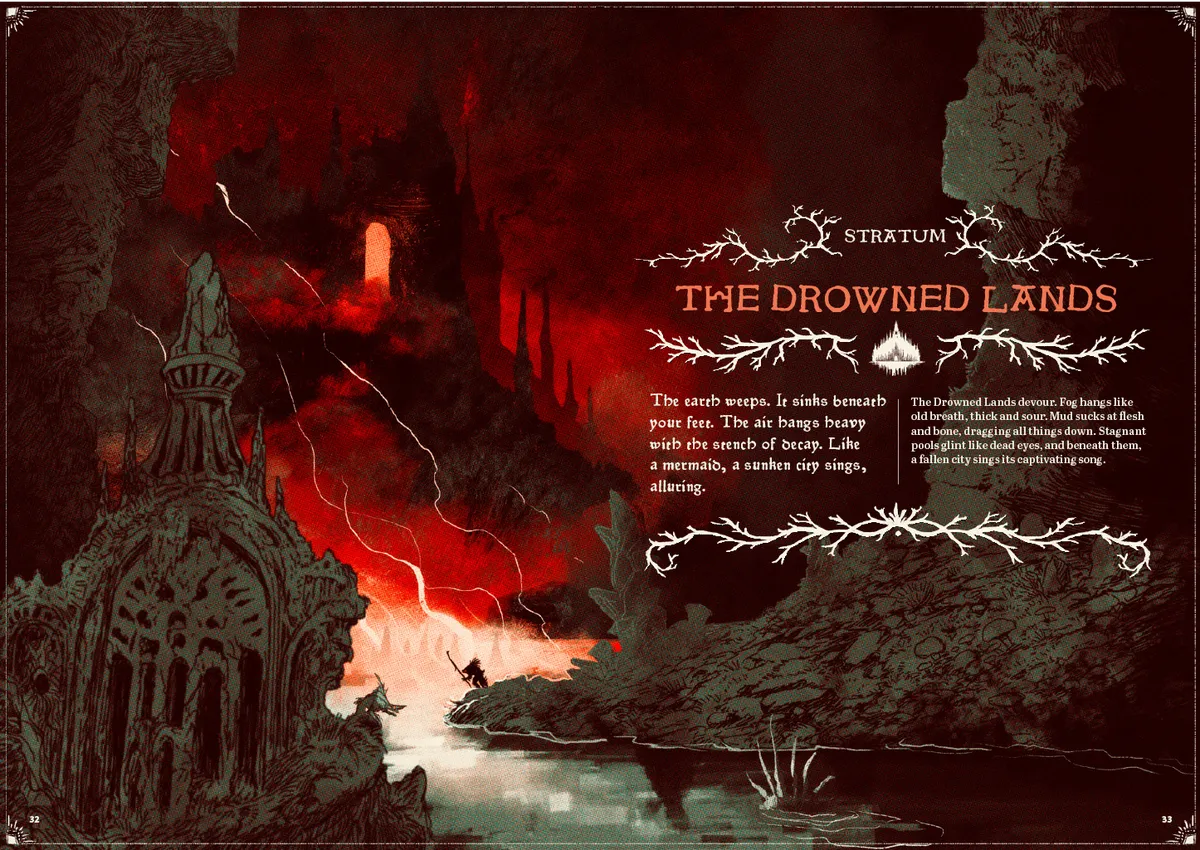
An amazing pitch to be sure, but the full book does little to make this world more concrete than the terrific art. Four “Strata” analogous to zones are included, each described in two two-page spreads - one a gorgeous landscape, the other a couple of paragraph summaries of the communities within. The tensions implicit within each community are juicy, but little work has been done to translate those tensions into a night of gaming. Each stratum lists three “Adventure Seeds” which act as two-to-four-sentence quest hooks, and from there GMs are left to fend for themselves. Here’s an example, reproduced in full:
The Nacreus Bell
A basalt tower long swallowed by the eruption emerges from the Stygian Sea. At night, a bell tolls from its insides, and the sea answers with rage, both from its waters and its monsters.
The Lord of Salt mutters words no Folk can decipher. The Circle wants the cabal to explore the tower and retrieve anything valuable before the Dredgefather’s outcasts claim it.
The proper nouns are all well-defined elsewhere, but the particulars of this circumstance are not. What sort of rage is the sea enacting? What is The Lord of Salt trying to say? What’s the interior of the tower like? Why does its bell enrage the sea? What valuables lie inside? All of that is left to the GM's discretion.4
This required prep work is more than just a pragmatic inconvenience. That lack of specificity lends the book a gazetteer, “view from nowhere” quality that hamstrings its ability to convey epic grandeur. Because of the enormous breadth the book chooses to address in a (rightfully) abbreviated structure, individual folk are, with a single exception, beneath the lore's notice. Size is a relation - the world can only seem big if the viewer is a small part of it. Even titans seem minuscule from a 10,000ft view. I wish I knew more, for contrast’s sake, about the parts of this world that are less powerful but more familiar.
The Rules
The Mörk Borg you’re all familiar with, with a smattering of house rules. Among the most notable:
- A fifth “Occult” stat is separated from Presence’s prior arcane domain.
- Death at 0hp is replaced with a gruesome wound table, about 1/3 of which results in death nonetheless.
- Mental HP, with its own accompanying mental wound table.
- Universal spellcasting via Eldritch negotiation.
- A Weapon Mastery combat feat system, randomly earned by surviving fights.
- "Pray to the Darkness": A Blades-style Devil's Bargain.
This was my first experience playing a Borg5, and I came away with a positive impression. I prefer player-rolled defense to monster-rolled attacks and I’m shocked that the armor die didn’t annoy me.6 Granted, I did not roll the armor die a single time, because every conflict either ended before the enemies could get a turn, did not damage player HP, or instantly killed them.
This is the most confusing part of the design. The book is overflowing with little feats that give -2 difficulty to this or that. Some are drip-fed once every 18 combats (on average), others chosen from five-to-ten-option pick lists of spells and optional starting 'traditions'. Yet despite all this fiddling, it’s quite easy to start the game with 1HP. One of my friends played the squishiest pregen character (3hp) and was decapitated by our game’s first d4 damage roll. This outcome was admittedly unlikely, but was no rarer than a critical hit.7 The death itself wasn't the problem - the table took their misfortune in stride and immediately substituted in a newly encountered pregen in classic dungeon game fashion. My point is that glacial incremental player-facing progression and high lethality make strange bedfellows.
Moreover, little compromise was made to this lethality in character generation. All those little mechanized traits add up. I timed myself when creating two separate characters - one rolled as randomly as possible, the other intentionally chosen using every optional rule (including a class system with bespoke feats). The former took me twelve minutes, the latter took thirty-one. The game's character sheet is gorgeous, but quickly bursts at the seams with “Test Presence DR 10 to discern weak spots in cave formations” and “After dealing damage with your balanced blade, you can make a second attack against the same target with a +2 DR penalty to the test. If used when dual wielding, this third attack is made with your primary hand.”
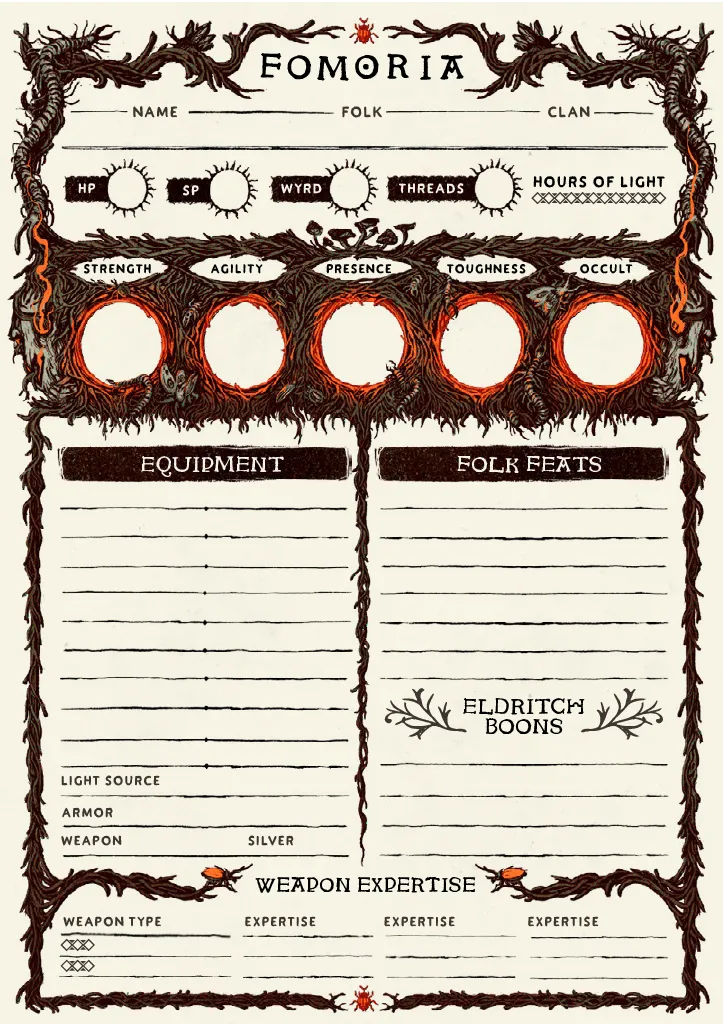
This is far from the only place where the game’s OSR roots feel in tension with Tania’s additions. Stat blocks are noticeably inflated - with around double the per-creature word count of other Borg supplements. Nothing is egregiously long here (this isn't Fabula); it's closer to the midpoint between Daggerheart and Cairn. Complexity peaks at "Six passive abilities and six randomly cycled attacks that each become sequentially disabled in 10hp increments”, which feels right for a Borg implementation of a Monster Hunter fight. I think, in this respect, she did well when balancing the principles her game holds in tension.
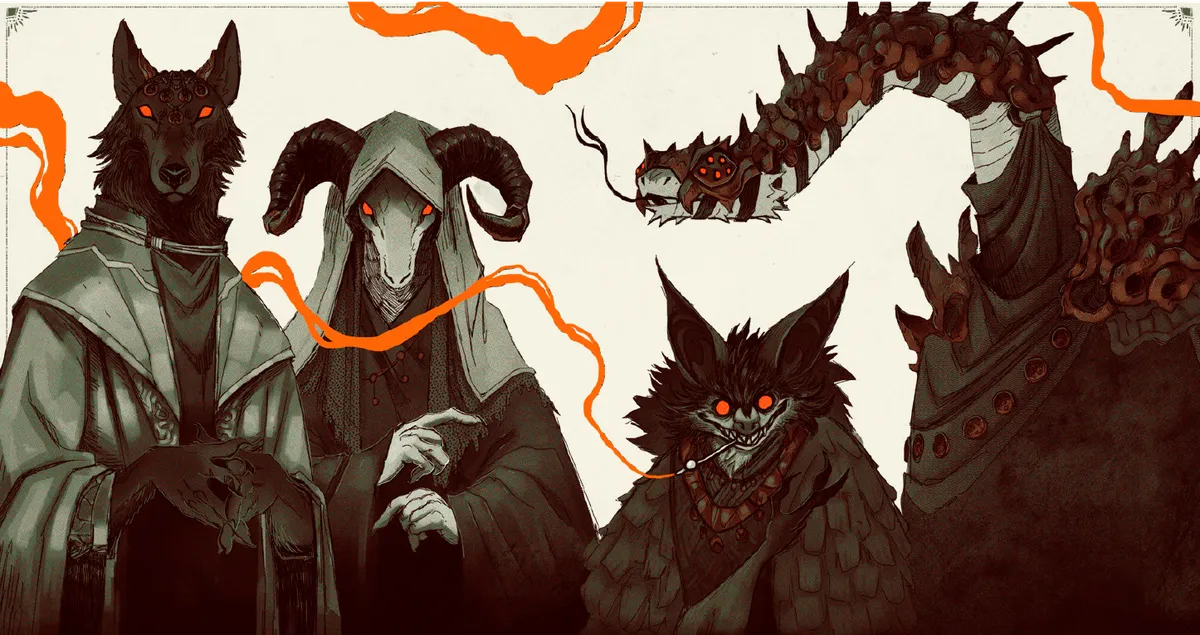
That being said, none of my quibbling is intended to besmirch the concepts for the monsters themselves. I think every single one is fantastic - so much so that the few souls out there with homebrewed Borg campaigns should consider picking Fomoria up as a creature compendium.
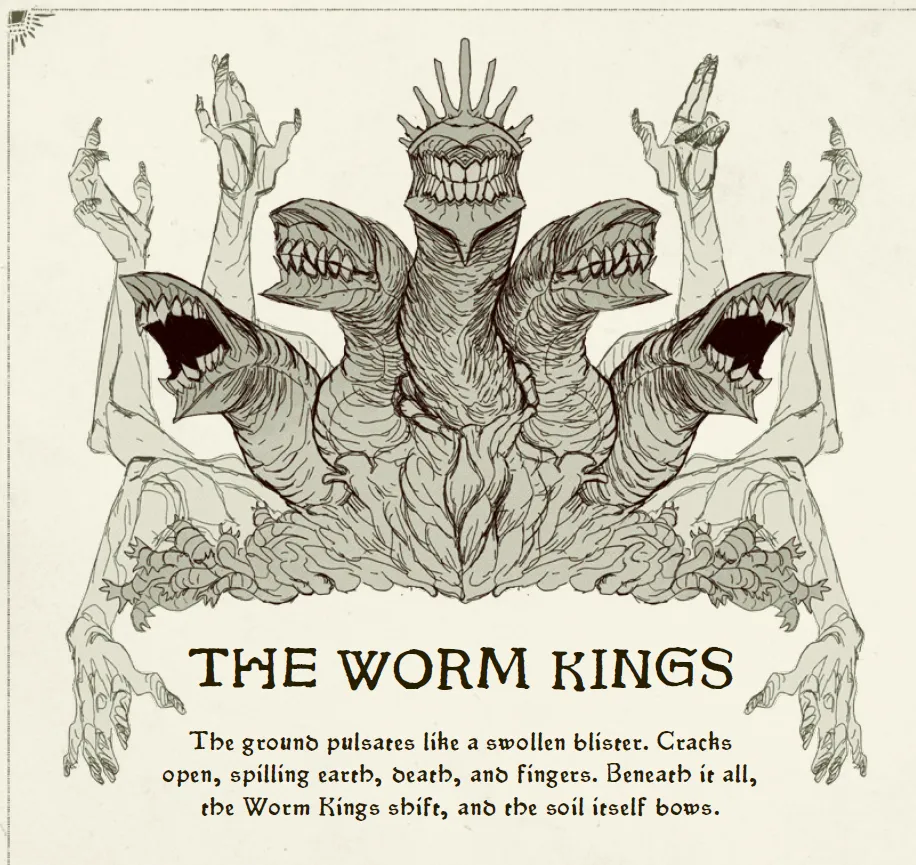
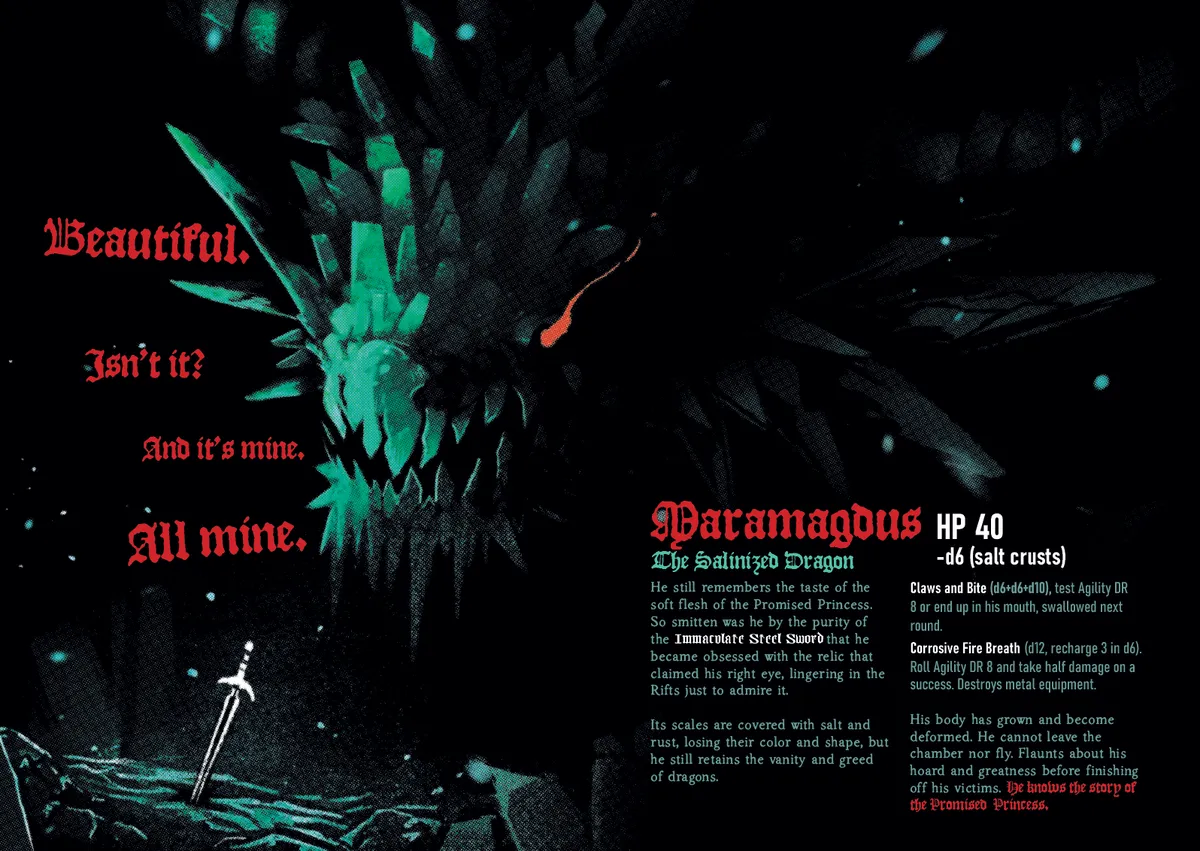
I mean, come on, look at this.
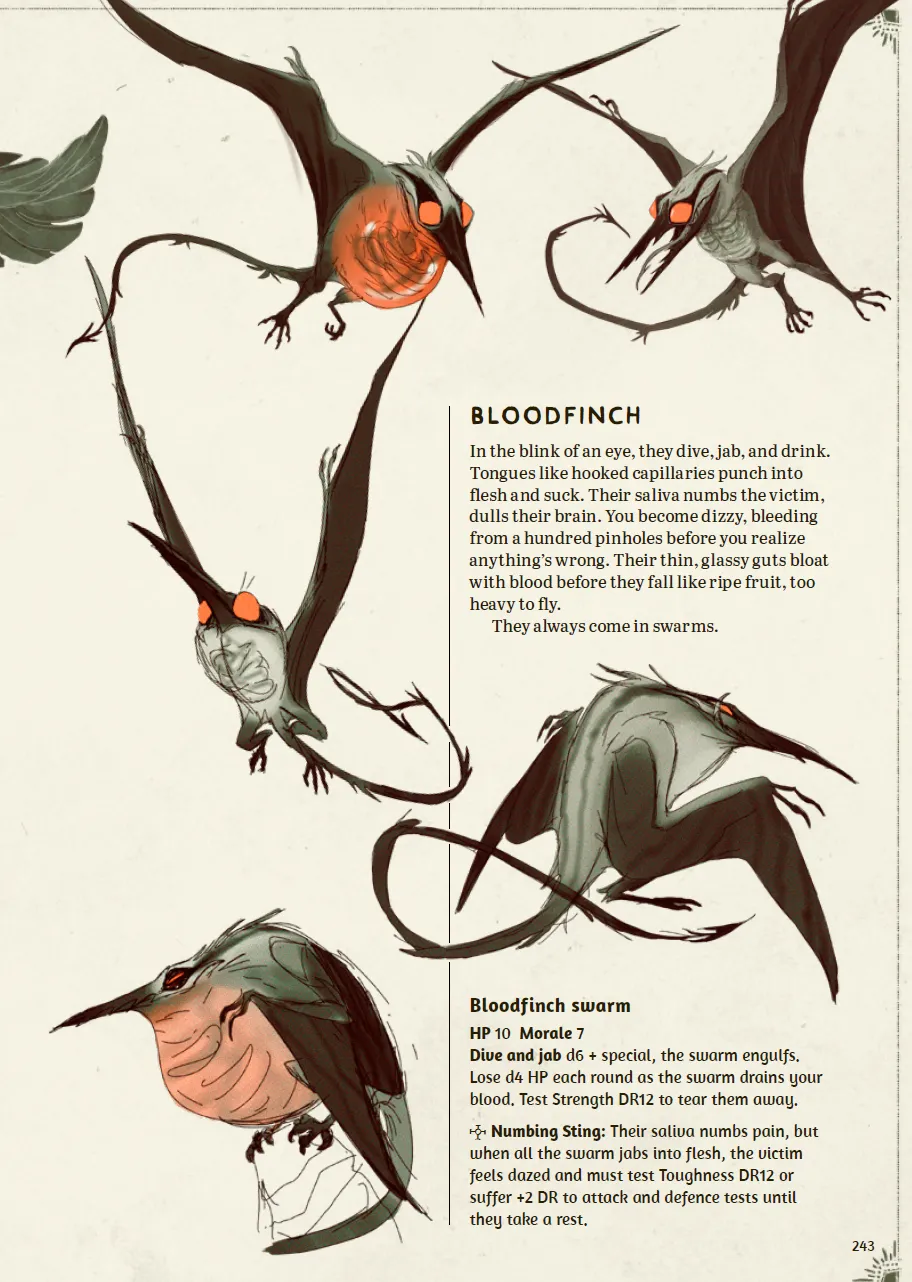
And these guys, check out these adorable sacks of garbage.
Johan even guest paints a few horrors to fantastic effect.
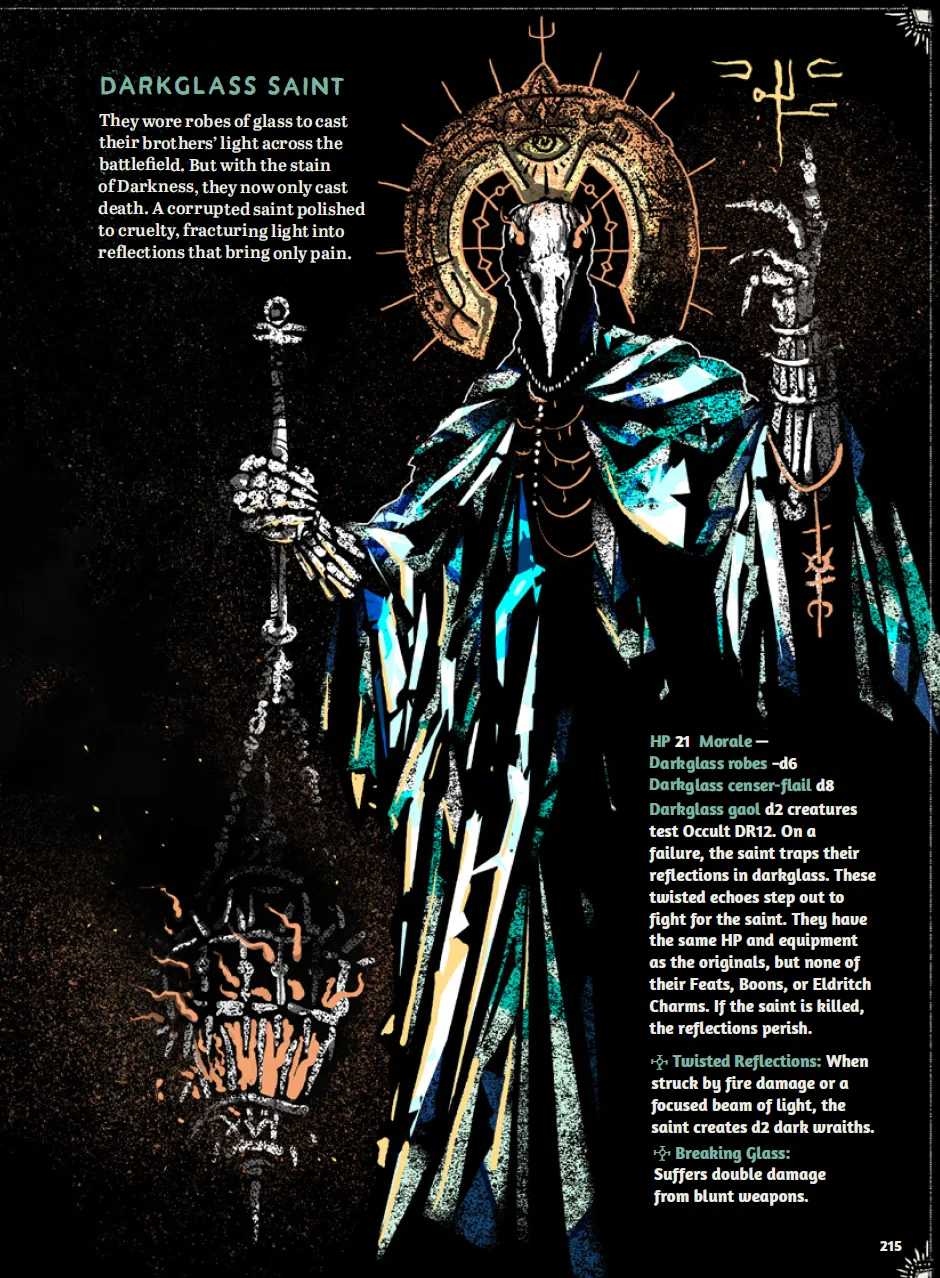
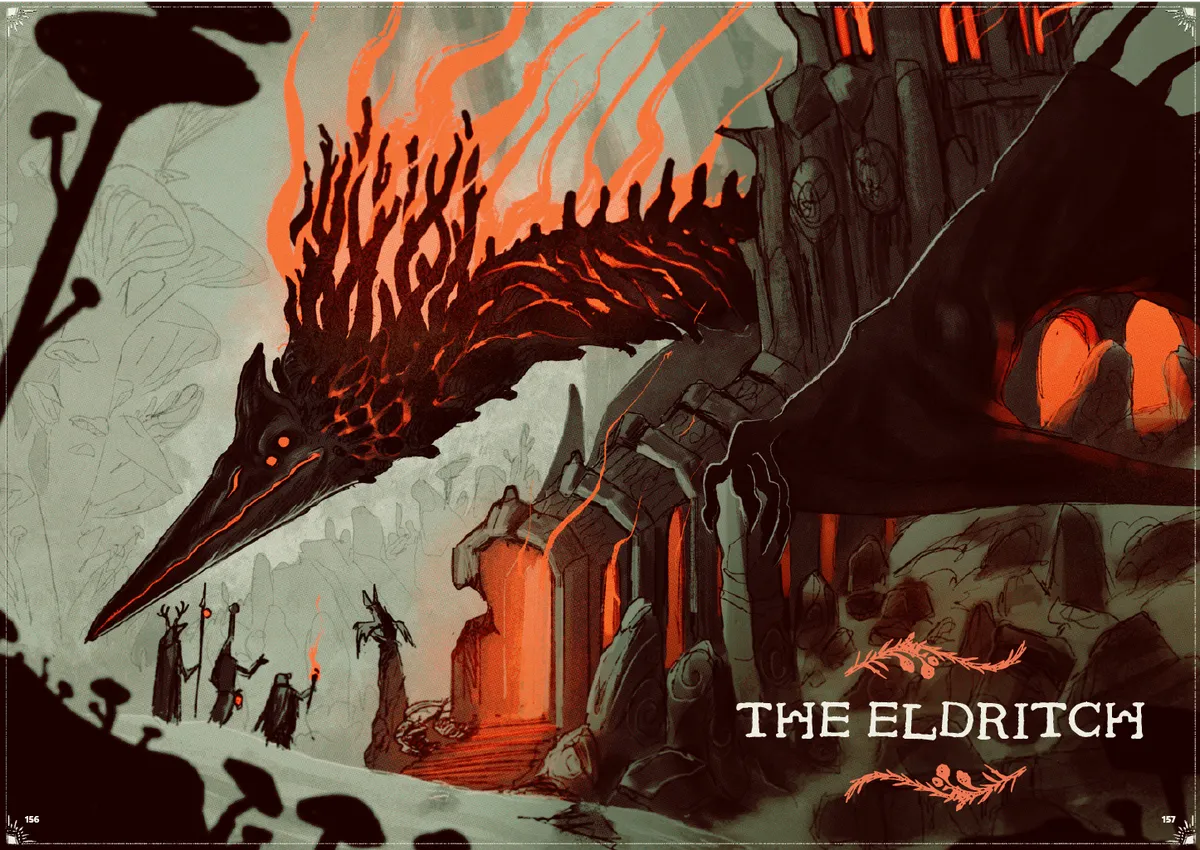
But that increased word count has other iffy knock-on effects. The wild, neon art pages that initially earned Tania’s acclaim are few and far between here - relegated mostly to the setting’s introduction. Johan opts for a sometimes dynamic, mostly traditional two-column black-on-white layout (similar to Tephrotic Nightmares) for readability, giving the majority of spreads in a book ostensibly about the grim darkness of caving a dissonantly bright parchment backdrop. I miss the bolder choices and rough edges of both of their earlier works.8
Compared to...
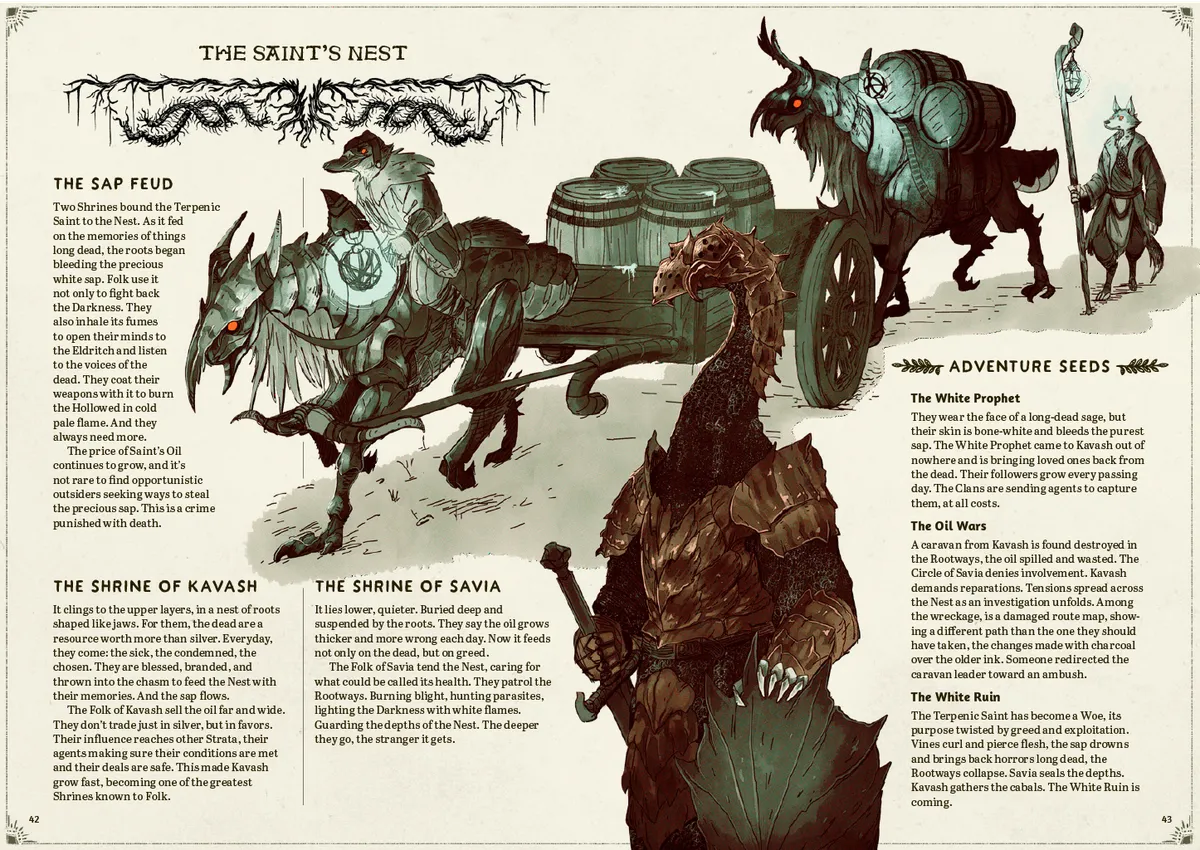
When you sum all of these qualities - the gorgeous professional art, the page count, the pragmatic layout, and the feat-heavy character generation - the book feels… surprisingly trad.
Is Fomoria Trad Borg?
No.
Compared to something like Symbaroum, let alone 5e, Fomoria’s complexity is positively restrained. But it’s a noticeable, if perhaps unintended, step in that direction.
As far as I can tell, it seems like neither Tania nor Johan is into theoryslop. They’re outrageously talented visual artists, not bloglodytes who mull over Blorb, Proceduralism, and Quantum Ogres. They both clearly adore the OSR, but Tania in particular seems to relate to it as an artistic movement that produces gorgeous fantasy tomes, not as a game design tradition. The quickstart adventure contains both an explicit homage to the giant from Deep Carbon Observatory, and a bunch of perception checks. Cultures determine play more than the systems produced by those cultures, so perhaps I shouldn't find it so jarring to see a designer nudge Mörk Borg in a heroic direction.
Please don’t misconstrue this as gatekeeping. These creators belong, and I am deeply thankful they are here. I’m trying to act as a historian documenting the philosophical atrophy of what Patrick Stuart himself calls “the Old OSR”, and the inheritor generation growing in its loam - a generation of which I consider myself a member. As a critic, I consider whinging about old wisdom to those who come after a crucial aim.
It is in that instructive spirit that I hope my last and most significant criticism of this book is taken.
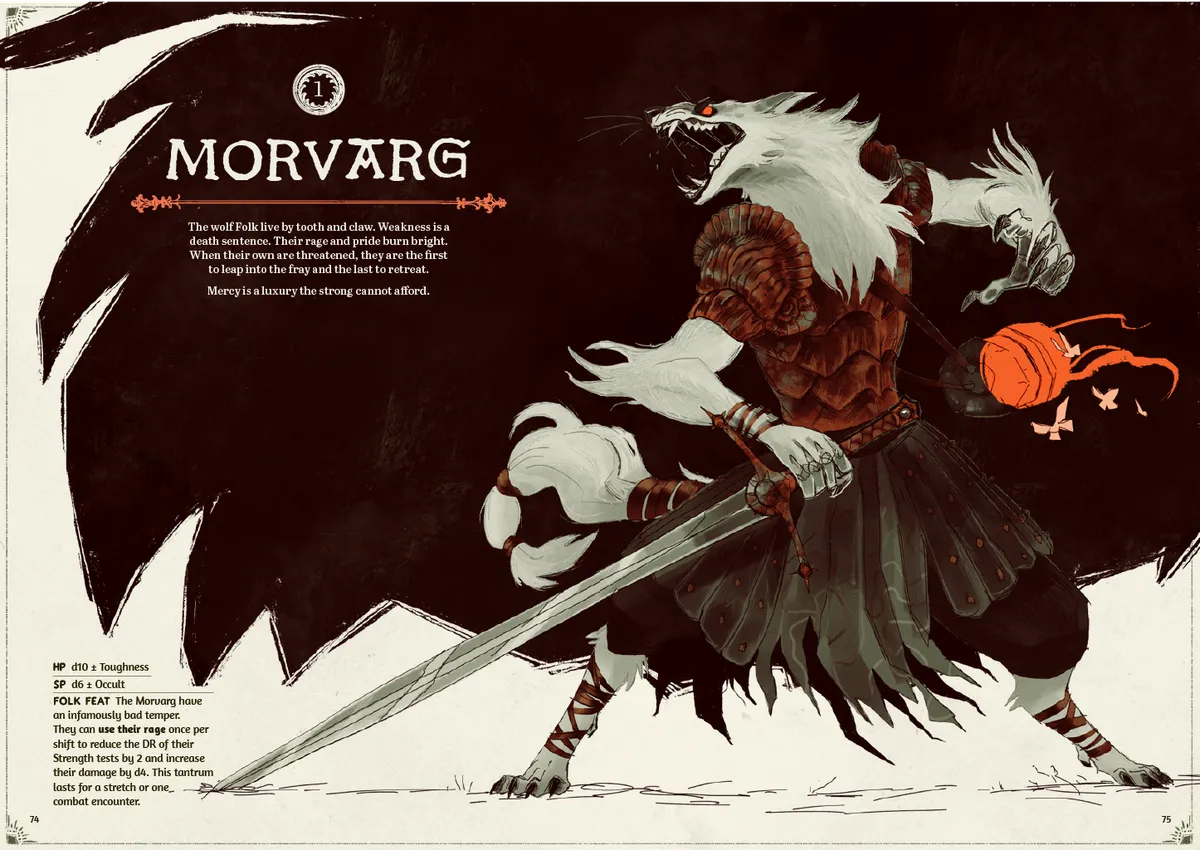
Why is everyone cool and good at swords?
A crucial insight of the modern grognards was the value of Picaresque play. D20 games are swingy, so your character is going to eat shit repeatedly. And that is good. That is relatable. The rules force you to be grounded and flawed.
Fomoria is stuffed, cover to cover, with aura farmers. Awesome-looking armored adventurers, straight out of an indie comic book, stoically holding fast against the encroaching darkness. That art and its accompanying progression mechanics make a promise that 3HP characters cannot guarantee - your players are just as likely to run headfirst into grappling with disability instead. If you want those injuries to be part of the challenges your players live with and overcome that's fine, but it makes me question why the personal hardships a campaign PC will inevitably accrue are never depicted in its art. Where are the missing eyes, fingers, limbs, teeth? Where's Mrs. Brisby, struggling desperately to pull her child from the bog? Coming from Tania's prior publications about love and duty and sacrifice, the "gritty heroism or bloody death" emotional landscape of Fomoria feels a little flat.
On the one hand, this isn’t that surprising. This project started as the daydream of a freshly minted college grad. Of course her comfort characters, digitally painted at the peak of the 2010s FromSoft craze, would be cool beautiful sword guys. But Fomoria was promised to grow into a world - almost certainly is a world, with all the drama and tragedy I’m asking for, in Tania’s head. But that emotional dynamism rarely makes it to the page. Maybe I’m just old, but I’m pretty tired of books that are 40% monsters, and 40% how to be good at killing monsters.
My Trust Remains
Most of my criticisms, save for the lethality / complexity mismatch9, could be solved by one great module - something to provide a fleshed out scenario, named supporting characters, and actual tension between the setting's factions. Considering that Tania herself wrote one of my favorite modules ever, this seems like a pretty realistic hope. The kickstarter promises a trifold scenario about caring for a definitely not haunted elder and a zine of "additional material and adventure" penned by Munkao and a gaggle of prominent Borg writers, so something table ready is coming. I'm also vain enough to admit that the production value of the GM screen, hireling cards, and standees could act as a tiebreaker between Fomoria and another fantasy contender when my Nasty Swamp campaign wraps up in a year.
So, until the physical books land on my doorstep, consider these mixed feelings my tentative judgement of a game that does not yet exist. Fomoria's strengths, for now, remain tied to its origins - the beautifully rendered nightmare of a dorky artist. Its chief purpose was never to fulfill consumer demand or a game design rubric.
Good for her.
$41.50 Hardcover, $21 Digital. Who knows how much for the supplementary gilded tchotchkes.
————————————————————————
Note that I was mailed a complimentary printed review copy of the Quickstart by Pit Trap Shop.↩
I was unsurprised to learn of her affections for Patrick Stuart and several Spanish poets.↩
Identical to the Quickstart, save for two much-appreciated additional spreads fleshing out the starting village - previously my chief complaint about the adventure.↩
Are there really folks out there who prefer this format to detailed location-based adventures? I’m starting to feel a bit “old man yells at cloud”, given how much I’ve complained about this. If so, [please tell me why!](will put the bsky link to this post here when it's published)↩
Despite previously comparing it to a sexy party stranger in the Daggerheart review. Mystery is attractive, what can I say?↩
May we all be as brave as Pelle Nilsson when he declared 'You know what D&D attack procedures need? A third dice roll.'↩
For this reason, I advise all campaigns to use the optional “Threads of Fate” rule - a fiddly daily reroll mechanic - to hedge against these boring deaths.↩
Crown of Salt didn't even have page numbers!↩
I've said before that player-objective mechanics are a topic I'm willing to compromise on to facilitate player buy-in, so this one stubborn flaw isn't a deal breaker.↩